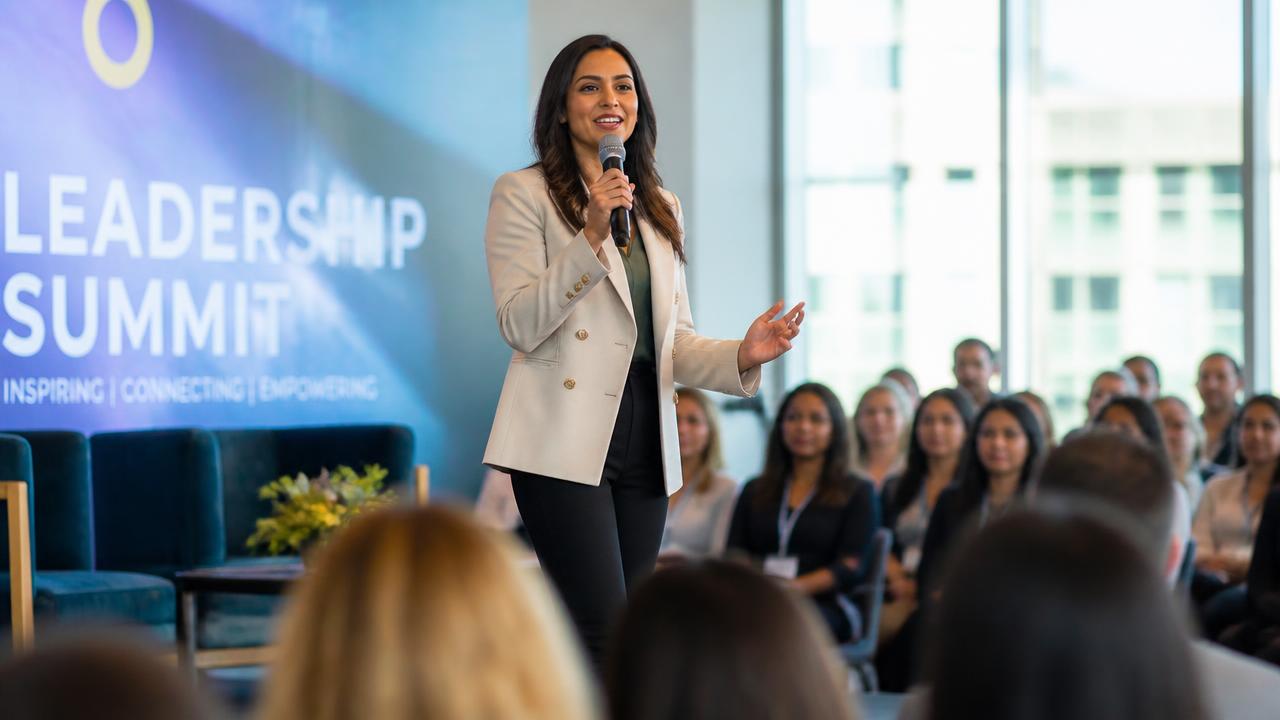
- Conference organizers are not looking for the biggest name. They are looking for the clearest pitch.
- Your speaker bio, your topic framing, and your pitch page do more work than your follower count.
- A Spotra speaker kit page is the fastest way to look like you belong on that stage before you have ever been on it.
Why follower count is the wrong metric
Most women who want to speak at conferences stop themselves before they start. They assume the stage is for people with bigger audiences, longer resumes, or more name recognition. That assumption is wrong and it is costing you opportunities you are already qualified for.
Conference organizers are not curating Instagram feeds. They are solving a programming problem. They need a speaker who can deliver a specific insight to a specific audience in a specific time slot. If you can do that and you can communicate it clearly, you are a candidate. Your follower count is not the filter. Your pitch is.
What conference organizers actually want to see
Before you write a single word of outreach, you need to understand what lands in the yes pile versus the maybe pile versus the delete pile. After talking to event organizers and program directors, the pattern is clear.
- A specific topic with a clear point of view, not a broad theme
- A speaker bio written for this audience, not copied from LinkedIn
- Evidence of the ability to deliver: a video clip, a past stage, a testimonial from an organizer
- A professional pitch page that makes it easy to say yes
- An outreach message that respects their time and gets to the point fast
How to write a speaker bio that works
Your speaker bio has one job: to make the organizer confident that booking you is a low-risk decision. It is not your resume. It is not your LinkedIn summary. It is a positioning statement written entirely from the perspective of what the organizer needs to hear.
Sarah is a marketing professional with over 10 years of experience in brand strategy, content creation, and digital marketing. She is passionate about helping businesses grow and has worked with companies of all sizes.
Sarah Ellis helps consumer brands rebuild trust after a growth stall. She led the repositioning that moved a $40M DTC brand from discount dependence to full price demand in nine months. She speaks on pricing power, brand trust, and what marketing leaders get wrong about loyalty.
The outreach message that gets replies
Organizers read pitches between meetings, on their phone, in a full inbox. Short and specific beats warm and vague every time. Lead with the audience benefit, prove you can deliver, then make the next step obvious.
Subject: Session idea for {event name}: {topic}
Hi {first name},
I saw that {event name} is programming around {theme} this year. I would like to propose a 25 minute session on {topic}, built for {audience}.
Why me: {one sentence of proof, a result, a role, or a number}. Attendees leave with {three concrete takeaways}.
Everything you need to evaluate me is on one page here: {your Spotra link}. Happy to adjust the framing to fit your track.
Thank you for the time, {your name}
Send ten of these before you judge the results. Follow up once after ten days. Most bookings come from the follow up, not the first send.
How to use your Spotra page as your pitch
An organizer deciding between two speakers will pick the one who is easier to say yes to. A Spotra speaker kit page puts your topics, your bio, your past stages, your clips, and your contact details in one link. No attachments, no scattered PDFs, no asking them to piece your credibility together from LinkedIn.
Put that single link in your outreach, your email signature, and your social bios. When someone says send me more, you already have.
Your 7-day action plan
One week. One hour a day. At the end of it you will have a page, a bio, and ten pitches in the world.
- Day 1Pick one topic and write your point of view in a single sentence.
- Day 2Write your speaker bio using the After example. Read it out loud once.
- Day 3Publish your Spotra speaker kit page. Done is better than perfect.
- Day 4Build a list of 15 events. Local, regional, and internal company events count.
- Day 5Find the right contact for each event. Program chair, curator, or community lead.
- Day 6Send 10 outreach messages using the template. Change only the first line.
- Day 7Log every send and set a follow up for 10 days out. Then keep going.
Spotra is building the visibility layer for talented people who are done waiting to be discovered. We write about self advocacy, positioning, and the practical work of being seen.
Read our story